Recently in IRS Notice Category

July 25, 2011

CP 90 Final Notice Intent to Levy: Understanding Your IRS Notice or Letter

First and foremost, you must respond to any IRS Notice.

If you receive a letter or notice from the IRS, it will explain the reason for the correspondence and provide specific instructions. Many of these letters and notices can be dealt with simply, without having to call or visit an IRS office.

The notice you receive covers a very specific issue about your account or tax return. Generally, the IRS will send a notice if it believes you owe additional tax, are due a larger refund, if there is a question about your tax return or a need for additional information.

Continue reading "CP 90 Final Notice Intent to Levy: Understanding Your IRS Notice or Letter" »

February 27, 2011

Tax Relief Specialists: How to Find a Reliable Tax Professional

Tax relief experts have a job pretty similar in nature to specialists of any other field. For example, if you are traveling on the road and suddenly your car breaks down due to a mechanical fault, you cannot fix it without the service of an expert mechanic, unless you possess such proficiencies. Likewise, when your IRS taxes get out of control due to financial problems, carelessness or any other reason, you need the help of a tax relief expert to carry on with your smoother journey of life. But there are many so-called experts you need to beware of, who are there only to take your money. Let us try to expose these scammers!

The American economic system relies heavily on the taxation system and this is why the IRS handles the individuals vehemently who try to evade taxes. However, in current cloudy financial circumstances paying taxes is not an easy job. If you have become a tax defaulter, need not worry because there are several legal ways out.

If you try to solve your IRS tax problems without the technical know-how expertise, it is just like trying to fix your broken car without the help of a mechanic and you will end up nowhere. If you do not want to waste your time and money, contact a reliable tax relief expert, as soon as you realize the tax problem. Procrastination will result in nothing but penalties and higher interest and you will be paying much more than the actual back taxes owed.

Is there a worse scenario than being haunted by the hostile IRS officers and you do not have enough money to pay back the taxes? Yes, if you fall a victim to fake tax relief experts. These scammers have interest in your money not in solving your problems. At the end of the day you will pay their huge fee, the whole tax amount plus penalties and interest.

The trustworthy tax relief experts usually offer free consultation before they take up your case. In this session you should ask them as many questions as you can, to assess their capabilities. If they are paying more attention to your money rather than your tax problem, go somewhere else to seek help.

On the other hand, there are honest and helpful experts who try to be as fair as possible as they know their client is in financial problems. These experts bear all the burden of representing you before the IRS, formulating the best solution for you and in the end, get you favorable results for a reasonable fee.


February 14, 2011

Tax Relief USA: IRS Tax Problems for American Citizens outside the United States

Tax relief USA is for the American citizens who are dwelling in the foreign countries. The taxation phenomenon becomes multifaceted and complex as you become taxable under the laws of two different countries. Most of the US expats do not know their rights and obligations as there is not much awareness among the commoners regarding the Tax Relief USA. This article describes the key points related to this relief program.

Let us suppose, if an American citizen is residing and working in Canada, he is obliged to pay the IRS taxes just like other citizens inside the United States. The taxpayer needs to learn the filing requirements the way they are based on American laws. However, this does not mean that he is not bound to pay the taxes under Canadian laws. Fortunately, IRS offers tax relief USA to such individuals which can lessen considerable financial burden.

So what is tax relief USA actually? Though the taxpayer must pay the taxes in both the countries but if the IRS believes that he is eligible for tax relief USA, he will either be given credit for the taxes paid in the foreign country or he will be entitled to exclude a part or the whole income earned outside the US.

There a few benefits including Canada Pension Plan, Old Age Security scheme etc. which are not taxable in the United States. Actually, this tax relief program is based on a tax treaty between the governments of the United States and Canada, which offers that such benefits would be taxed utterly on the base of current residence. In the same way, the above mentioned benefits come to be taxable if the taxpayer obtains them while residing in the USA.

Therefore, these Canadian social security benefits are preceded just like their American counterparts because of the United States tax. However, in case any of such benefits is not subject to taxation in the hands of a Canadian resident, the same benefit is not taxable in the United States.

Obviously this is not a straightforward procedure and having different taxation laws for different countries, legal tax expertise are required to understand it thoroughly. It is sensible to contact a tax relief expert to understand your rights and responsibilities.

February 1, 2011

How to stop an IRS wage garnishment

If you have received an IRS wage garnishment notice, then the IRS is going to apply a levy deduction to your hard earned paycheck, it also means that the IRS notifies your employer that you have unpaid back taxes. Your employer is then required by law to withhold and send a significant portion of each of your paychecks directly to the IRS to offset your tax debt.

Please note, that if you do not respond, the IRS will gladly continue to garnish your paycheck until your tax debt is paid in full with all the penalties and interest.

With our firm, you do not need to take on the IRS by yourself. We will work with the IRS to negotiate a full or partial levy release of your wage garnishment if you qualify for tax relief. Depending upon your own individual circumstances, we may arrange an installment agreement so you can pay the IRS a specified dollar amount every month until the unpaid taxes are paid. Once the negotiated installment agreement is in place, an offer-in-compromise may be also negotiated to settle your entire tax debt for less than you actual owe, depending on your individual financial circumstances.

Another option is to be placed in a CNC - currently not collectible status, in which you may not have to make payments to the IRS at all, again depending on your particular financial circumstances. In today's economy, most taxpayers are in a financial hardship, and now is the time to resolve your unpaid back taxes once and for all.

Please call to set up a free confidential consultation to review your options and take the stress out of dealing with your IRS wage garnishment notice.

Now is the time to act. We deal with the IRS so you don't have to.

Call Mike Habib, EA at 1-877-788-2937 to end your tax problem nightmare.

IRS wage garnishment release offered in areas such as: Los Angeles, Whittier, Pasadena, Glendale, Burbank, Orange County, Riverside, Palm Springs, San Bernardino, Palmdale, Bakersfield, New York, New Jersey, Chicago, Houston, Phoenix, Philadelphia, San Antonio, San Diego, Dallas, San Jose, Detroit, Jacksonville, Indianapolis, San Francisco, Columbus, Austin, Memphis, Fort Worth, Baltimore, Charlotte, El Paso, Boston, Seattle, Washington DC, Milwaukee, Denver, Louisville, Jefferson, Las Vegas, Reno, Hempstead, Tucson, Nashville, Davidson, Portland, Tucson, Albuquerque, Santa Fe, Anchorage, Atlanta, Long Beach, Fresno, Sacramento, Mesa, Kansas City, Cleveland, Virginia Beach, Omaha, Miami, Oakland, Tulsa, Honolulu, Minneapolis, Pittsburgh, Colorado Springs, Arlington, Wichita, Birmingham, Montgomery, Tampa, Orlando

January 25, 2011

Tax Attorney Services for IRS Tax Problems

Life is a mixture of sunshine and rain, happiness and sadness, success and obstacles, ups and downs. As a matter of fact, majority of people experience more sorrows and less pleasure during their lives. But there are some grave problems than can make you forget all other problems. IRS tax problems are obviously one of these. The worst thing is that most of the people do not know where to go for help and then there are those who even do not bother trying to seek help.

IRS is the considered the most cruel collection agency on the globe and they care about only one thing, their money and they will do anything to recover it. IRS bank levy, IRS tax lien, IRS wage garnishment are the most lethal collection weapons of IRS that can cause immense problems even for well-heeled individuals and organizations.

There are many tax resolution firms that try to rip off their clients but we understand that our clients are already facing financial problems. Our prime target is to solve your problems and that is how we have built our reputation and credibility.

If you are facing IRS tax problems and you cannot find a way to resolve them, we can take this burden off your shoulders. Dealing with IRS problems and pressure is our everyday job. We have a history of solving such problems which you can learn more at myirstaxrelief.com. There would be enough other problems in your life to keep you busy, leave the IRS problems to us. Whenever you are in fear of tax levies, tax liens, wage garnishment, unpaid tax debt or any other IRS tax issue, Mike Habib, EA Tax Relief Services is here for you.

Bringing in to practice our experience and expertise, we handle each case with utmost confidence and carefulness. You will be bothered by the aggressive IRS officers no more and we will help you to find the best resolution by making better accurate analysis of your case.

Remember, every problem has a solution. No matter you have received a notice from the IRS, your wages have been garnished, you simply need advice or whatever the problem is, when Mike Habib, EA Tax Relief Services takes on your case, you should expect positive results.

November 1, 2010

IRS Tax Audits: Payroll Tax Audit: Colleges IRS Audit

Employment and Payroll Tax Audit & Examination:
The IRS announced its plan to audit the first 6,000 employment tax audits and small business will be their audit target. The IRS will start examining 2,000 companies every year over the next 3 years.

The IRS will utilize its audit findings to target a select group of businesses and aggressively audit their payroll tax and refine estimates to close the tax gap. IRS audit agents are specially trained to audit employment and payroll tax for the audited businesses.

Colleges and Universities Tax Audits:
The IRS will audit 400 Colleges and Universities this year. The IRS is looking for unrelated business income to focus its examination at. The IRS suspects that many universities aren't paying taxes on income from unrelated activities to their tax-exempt status, for example: stadium advertising, gym memberships, and executive pay.

Contractors with unpaid back taxes:
The IRS is cracking down hard on contractors with unpaid back taxes. The current Obama administration is developing new regulations to prevent federal contractors from receiving any government contracts as long as they owe back tax debt. In 2008, procedures were in place to prevent any contractor from bidding on government contacts if they owed $3,000 or more in tax liens and or tax judgments to the IRS.

The Revenue Service is also eyeing projects that use rehabilitation credit. IRS Agents have spotted developers claiming the 20% income tax credit on the cost of renovating certified historic buildings before they have the necessary documentation from the National Park Service to certify that the subject project is in fact historic in nature. The IRS will crack down on developers who are performing Historic structure renovations.

Employers with unpaid FICA on tips:
The IRS is sending out bills to employers such as restaurants and hotels to collect on unpaid FICA on unreported tips using data they collected from form 4137 which employees use to report tip income that they didn't disclose to their employers. The IRS is sending letters to these employers instructing them to include their calculated amount on their next scheduled payroll deposit. Employers who comply will avoid any penalties and interest on the back taxes. The IRS is also revising the 4137 form to include the employer's EIN number.

Mike Habib EA actively represents taxpayers in audits and examination before all administrative levels of the IRS. Don't compromise on your representation, contact us today.

Get your free audit consultation by calling 1-877-788-2937.

October 4, 2010

Third Quarter 2010 Tax Developments - Part 3

Relief for homeowners with corrosive drywall. The IRS is allowing individuals with corrosive drywall to apply a safe harbor formula to treat the costs of repairing the defective drywall as a casualty loss. The safe harbor applies for original and amended federal income tax returns filed after Sept. 29, 2010. Reported problems have occurred with certain imported drywall installed in homes between 2001 and 2008. Homeowners have reported blackening or corrosion of copper electrical wiring and copper components of household appliances, as well as the presence of sulfur gas odors. In the case of any individual who pays to repair damage to his personal residence or household appliances that results from corrosive drywall, the IRS won't challenge his treatment of damage resulting from corrosive drywall as a casualty loss (which might otherwise be difficult to achieve under the regular rules) if the loss is determined and reported under the safe harbor rule. A taxpayer who does not have a pending claim for reimbursement may claim as a loss all unreimbursed amounts paid during the tax year to repair damage to his personal residence and household appliances resulting from corrosive drywall. A taxpayer who has a pending claim (or intends to pursue reimbursement) may claim a loss for 75% of the unreimbursed amount paid during the tax year to repair damage to the taxpayer's personal residence and household appliances that resulted from corrosive drywall.

Over-the-counter drug costs will no longer be reimbursable. Effective Jan. 1, 2011, unless prescribed or insulin, the cost of over-the-counter medicines cannot be reimbursed from flexible spending arrangements (FSA), health reimbursement arrangements (HRA), Health Savings Accounts (HSA) and Archer Medical Savings Accounts (Archer MSA). The IRS has issued guidance explaining that an individual may be reimbursed for over-the counter medicines or drugs, so long as the individual obtains a prescription for the medicines or drugs. It also makes clear that expenses incurred for over-the-counter medicines or drugs purchased without a prescription before Jan. 1, 2011 may be reimbursed tax-free at any time by an employer-provided plan, including an FSA or HRA, under the terms of the employer's plan.

Simplified per diem rates lowered effective Oct. 1, 2010. Reimbursements of an employee's business travel costs (lodging, meal and incidental expenses (M&IE)) at a per diem rate are payroll-and income-tax free if simplified substantiation is provided and the daily rate doesn't exceed the federal per diem rate (the maximum amount that the federal government reimburses its employees) for the locality of travel for that day. While the per diem rates vary by travel destination, employers can make reimbursements at the simplified "high-low" per diem rates, which assign one per diem rate to high-cost areas within the continental U.S., and another to non-high-cost areas. The IRS has issued the "high-low" simplified per diem rates for post-Sept. 30, 2010, travel. An employer may reimburse up to $233 for high-cost localities ($168 for lodging and $65 for M&IE) and $160 for other localities ($108 for lodging and $52 for M&IE). The list of high-cost areas is also updated.

October 3, 2010

Third Quarter 2010 Tax Developments - Part 2

Guidance explains longer NOL carryback option for businesses. The IRS has issued guidance in a question and answer (Q&A) format to address a number of specialized issues that have arisen under the new optional longer net operating loss (NOL) carryback period that was provided by the Worker, Homeownership, and Business Assistance Act of 2009 (WHBAA). Under WHBAA, an irrevocable election of a 3, 4, or 5-year carryback period for an applicable NOL for a tax year ending after Dec. 31, 2007, and beginning before Jan. 1, 2010, is generally available for one tax year (except for an eligible small business (ESB) loss). The WHBAA election is an expansion of the increased carryback period election provided by the American Recovery and Reinvestment Act of 2009 (ARRA), which was available only to ESBs, and only for 2008 NOLs. The guidance addresses many questions left unanswered by the statutory provisions. For example, it makes clear that if a taxpayer previously made an ARRA election, it doesn't have to continue to qualify as an ESB in the year of the WHBAA NOL in order to make a WHBAA election. A taxpayer must qualify as an ESB only for the tax year of the ARRA election. Also, the IRS has revised the Instructions for Form 1139, Corporation Application for Tentative Refund (Rev. August 2010), to explain how businesses make the WHBAA election.

Regulations on election to defer COD income. For debt discharges in tax years ending after Dec. 31, 2008, a taxpayer may elect to have any cancellation of debt (COD) income from the reacquisition of an applicable debt instrument after Dec. 31, 2008, and before Jan. 1, 2011, included in gross income ratably over five tax years. The IRS has issued two sets of regulations on this rule: one applies to C corporations, the other applies to partnerships and S corporations. The regulations cover many complicated issues that arise with the election. For example, the C corporation regulations cover topics such as acceleration of deferred cancellation of debt (COD) income and deferred original issue discount deductions, and the calculation of earnings and profits as a result of making an election.

Legislation ends foreign loopholes and advance EITC. The Education Jobs and Medicaid Assistance Act, which was signed into law on August 10, 2010, includes provisions closing a number of foreign-tax-credit related loopholes and repealing the advanced earned income tax credit (EITC). Specifically, this legislation tightens the rules on the use of foreign tax credits that multinationals use to lower their U.S. tax bill. In general, these provisions attempt to (1) make foreign tax credits (FTCs) available only when the income to which the FTCs relate is actually taxed by the U.S., (2) prevent artificial inflation of foreign source income, and (3) modify the resourcing rules to limit FTCs. Also, under the new law, starting in 2011, eligible low- and moderate-income workers who qualify for the EITC will no longer be able to elect to receive the credit in advance.

Financial reform package changes mark-to-market rule. The "Restoring American Financial Stability Act of 2010" was signed into law on July, 21, 2010. This landmark financial reform package contained a tax provision broadening the list of contracts that are excepted from mark-to-market treatment. Taxpayers must report gains and losses from regulated futures contracts and other "Section 1256 contracts" on an annual basis under the "mark-to-market" rule. The term Section 1256 contract means: regulated futures contracts, foreign currency contracts, nonequity options, dealer equity options, and dealer securities futures contracts. It does not include any securities futures contract or option on such a contract unless the contract or option is a dealer securities futures contract. Under the new law, for tax years beginning after July 21, 2010, all of the following also are excepted from the definition of a Section 1256 contract: any interest rate swap; currency swap, basis swap, interest rate cap, interest rate floor, commodity swap, equity swap, equity index swap, credit default swap, or similar agreement.

September 28, 2010

2010 Small Business Jobs Act : Important Points

The recently enacted 2010 Small Business Jobs Act includes a wide-ranging assortment of tax breaks and incentives for businesses. Here's a brief overview of the tax changes in the Small Business Jobs Act.

Enhanced small business expensing (Section 179 expensing). To help small businesses quickly recover the cost of capital outlays, small business taxpayers can elect to write off these expenditures in the year they are made instead of recovering them through depreciation. Under the old rules, taxpayers could generally expense up to $250,000 of qualifying property--generally, machinery, equipment and software--placed in service in during the tax year. This annual limit was reduced by the amount by which the cost of property placed in service exceeded $800,000. Under the Small Business Jobs Act, for tax years beginning in 2010 and 2011, the $250,000 limit is increased to $500,000 and the investment limit to $2,000,000. The Small Business Jobs Act also makes certain real property eligible for expensing. Thus, for property placed in service in any tax year beginning in 2010 or 2011, the $500,000 amount can include up to $250,000 of qualified leasehold improvement, restaurant and retail improvement property.

Extension of 50% bonus first-year depreciation. Before the Small Business Jobs Act, Congress already allowed businesses to more rapidly deduct capital expenditures of most new tangible personal property placed in service in 2008 or 2009 by permitting the first-year write-off of 50% of the cost. The Small Business Jobs Act extends the first-year 50% write-off to apply to qualifying property placed in service in 2010 (as well as 2011 for certain aircraft and long production period property).

Boosted deduction for start-up expenditures. The Small Business Jobs Act allows taxpayers to deduct up to $10,000 in trade or business start-up expenditures for 2010. The amount that a business can deduct is reduced by the amount by which startup expenditures exceed $60,000. Previously, the limit of these deductions was capped at $5,000, subject to a $50,000 phase-out threshold.

100% exclusion of gain from the sale of small business stock. Ordinarily, individuals can exclude 50% of their gain on the sale of qualified small business stock (QSBS) held for at least five years (60% for certain empowerment zone businesses). This percentage exclusion was temporarily increased to 75% for stock acquired after Feb. 17, 2009 and before Jan. 1, 2011. Under the Small Business Jobs Act, the amount of the exclusion is temporarily increased yet again, to 100% of the gain from the sale of qualifying small business stock that is acquired in 2010 after September 27, 2010 and held for more than five years. In addition, the Small Business Jobs Act eliminates the alternative minimum tax (AMT) preference item attributable to such sales.

General business credits of eligible small businesses for 2010 get five-year carryback. Generally, a business's unused general business credits can be carried back to offset taxes paid in the previous year, and the remaining amount can be carried forward for 20 years to offset future tax liabilities. Under Small Business Jobs Act, for the first tax year of the taxpayer beginning in 2010, eligible small businesses can carry back unused general business credits for five years instead of just one. Eligible small businesses are sole proprietorships, partnerships and non-publicly traded corporations with $50 million or less in average annual gross receipts for the prior three years.

General business credits of eligible small businesses not subject to AMT for 2010. Under the AMT, taxpayers can generally only claim allowable general business credits against their regular tax liability, and only to the extent that their regular tax liability exceeds their AMT liability. A few credits, such as the credit for small business employee health insurance expenses, can be used to offset AMT liability. The Small Business Jobs Act allows eligible small businesses to use all types of general business credits to offset their AMT in tax years beginning in 2010.

Deductibility of health insurance for the purpose of calculating self-employment tax. The Small Business Jobs Act allows business owners to deduct the cost of health insurance incurred in 2010 for themselves and their family members in calculating their 2010 self-employment tax.

Cell phones no longer listed property. This means that cell phones can be deducted or depreciated like other business property, without onerous recordkeeping requirements.
S corporation holding period for appreciated assets shortened to five years. Generally, a C corporation converting to an S corporation must hold onto any appreciated assets for 10 years or face a built-in gain tax at the highest corporate rate of 35%. The 2010 Small Business Jobs Act temporarily shortens the holding period of assets subject to the built-in gains tax to 5 years if the 5th tax year in the holding period precedes the tax year beginning in 2011.

New tax break for long-term contract accounting. The Small Business Jobs Act provides that in determining the percentage of completion under the percentage of completion method of accounting, bonus depreciation in 2010 is not taken into account as a cost. This prevents the bonus depreciation from having the effect of accelerating income.
Limitation on penalty for failure to disclose certain reportable transactions. The Small Business Jobs Act generally limits the penalty to 75% of the decrease in tax resulting from the transaction, retroactively to penalties assessed after Dec. 31, 2006. Minimum and maximum penalties apply.

Revenue raisers. These tax breaks come at a cost. To mention a few of these unfavorable provisions, information reporting will generally be required for rental property expense payments made after Dec. 31, 2010, and increased information return penalties will be imposed.

Please keep in mind that I've described only the highlights of the most important changes in the Small Business Jobs Act. If you would like more details about any aspect of the new legislation, please do not hesitate to contact us.

August 26, 2009

Who said the IRS is not generous?

IRS Sends $122,783 Check by Mistake

House Cleaner Sensed it was an Error and Returned Check; IRS won't Comment

SOURCE: CBS

A Denver-area house cleaner could hardly believe her eyes when she opened up the mail. She was expecting to pay the Internal Revenue Service, but instead she received a refund check for more than $100,000.

Laura Schultz readily admits she's not a wealthy woman. Her job with Sunshine Maids does not put her in the category that would bring a refund in the hundreds of thousands of dollars; but the IRS sent her a check for $122,783.51.

"It didn't make sense," Schultz said.

It certainly was a real check.

"I didn't feel I was owed that much money, so I called the IRS," Schultz said. "They told me to void it."

CBS4's Rick Sallinger asked the IRS what would happen if somebody decided to keep a mistaken $122,000 check. An official said if they were caught they'd have to pay it back, plus interest.

Schultz voided the check as the IRS requested.

"I feel pretty good about turning it in."

The IRS says it cannot comment on what caused the error, but Schultz still has to pay the $80 she owed.

July 23, 2009

IRS Urgent Letters and Notices

IRS Urgent Letters and Notices That YOU MUST ATTEND TO

Mike Habib, EA

IRS Audit & Examination Letters

Letter 525 - General 30 Day Letter

This letter accompanies a report giving you a computation of the proposed adjustments to your tax return. It informs you of the courses of action to take if you do not agree with the proposed adjustments. The letter explains that if you agree with the adjustment, you sign and return the agreement form. If you do not agree, you can submit a request for appeal/protest to the office/individual that sent you the letter. The letter or referenced publications explain how to file a protest. You need to file your protest within 30 days from the date of this letter in order to appeal the proposed adjustments with the Office of Appeals.

Letter 531 - Notice of Deficiency

This letter is notice of the Commissioner's determination that you owe additional tax or other amounts for the tax year(s) identified in the letter. The Internal Revenue Code authorizes the Commissioner to send this notice. The letter explains how to dispute the adjustments in the notice of deficiency if you do not agree. To dispute the adjustments without payment, you file a petition with the Tax Court within 90 days from the notice date.

Letter 692 - Request for Consideration of Additional Findings

This letter accompanies a report giving you a computation of the proposed adjustments to your tax return. It informs you of the courses of action to take if you do not agree with the proposed adjustments. The letter explains that if you agree with the adjustment, you sign and return the agreement form. If you do not agree, you can submit a request for appeal/protest to the office/individual that sent you the letter. The letter or referenced publications explain how to file a protest. You need to file your protest within 15 days from the date of this letter in order to appeal the proposed adjustments with the Office of Appeals.

Letter 1153 - Trust Funds Recovery Penalty Letter

This letter explains that the IRS's efforts to collect the federal employment or excise taxes due from the business named on the letter have not resulted in full payment of the liability. Therefore, the IRS proposes to assess a penalty against you. If you agree with this penalty for each tax period shown, you are asked to sign Part 1 of the enclosed Form 2751 and return it to the person/office that sent you the letter. If you do not agree you can submit a request for appeal/protest to the office/individual that sent you the letter. The letter or referenced publications explain how you file a protest. You need to file your protest within 60 days from the date of the letter in order to appeal this decision with the Office of Appeals.

Letter 1389 - 30 Day Letter, Tax Shelter Activity

This letter accompanies a report giving you a computation of the proposed adjustments the IRS made to your tax return because of your tax shelter activity. It informs you of the courses of action to take if you do not agree with the proposed adjustments. The letter explains that if you agree with the adjustment, you sign and return the agreement form. If you do not agree, you can submit a request for appeal/protest to the office/individual that sent you the letter. The letter or referenced publications explain how you file a protest. You need to file your protest within 30 days from the date of this letter in order to appeal the proposed adjustments with the Office of Appeals.

Letter 3016 - IRC Section 6015 Preliminary Determination Letter (30 Day)

This is a preliminary letter giving you 30 days to appeal the determination for innocent spouse relief under IRC Section 6015. The letter explains that if you do not agree with the determination you can submit a request for appeal/protest to the office/individual that sent you the letter. The letter explains how you file a protest. You need to file your protest within 30 days from the date of this letter in order to appeal the proposed adjustments with the Office of Appeals.

Letter 3391 - 30-Day Nonfiler Letter

This letter advises you the IRS believes you are liable for filing tax returns for the periods identified in the letter. It includes a report giving you a computation of the proposed adjustments to your tax return and explains the adjustments. The letter explains that if you agree with the adjustments, you sign and return the agreement form. If you do not agree, you can submit a request for appeal/protest to the office/individual that sent you the letter. The letter or referenced publications explain how to file a protest. You need to file your protest within 30 days from the date of this letter in order to appeal the proposed adjustments with the Office of Appeals.

Letter 3727 - 30-Day Letter Notifying Taxpayer No Change to Original Report Disallowing EIC Based on Failure to Meet Residency Test for Children Claimed

This letter explains why the IRS will not allow your earned income credit (EIC). The letter explains that if you agree with the adjustment, you sign and return the agreement form. If you do not agree, you can submit a request for appeal/protest to the office/individual that sent you the letter. The letter or referenced publication explains how to file a protest. You need to file your protest within 30 days from the date of this letter in order to appeal the proposed adjustments with the Office of Appeals.

Letter 3728 - 30-Day Letter Notifying Taxpayer No Change to Original Report Partially Disallowing EIC Based on Failure to Meet Residency Test for 1 Child

This letter explains why the IRS can only give you part of your earned income credit (EIC). The letter explains that if you agree with the adjustment, you sign and return the agreement form. If you do not agree, you can submit a request for appeal/protest to the office/individual that sent you the letter. The letter or referenced publication explains how to file a protest. You need to file your protest within 30 days from the date of this letter in order to appeal the proposed adjustments with the Office of Appeals.

IRS Tax Debt Collection Letters

Letter 11 - Final Notice of Intent to Levy and Notice of Your Right to a Hearing

This letter is to notify you of your unpaid taxes and that the Service intends to levy to collect the amount owed. The letter and referenced publications explain how to request an appeal if you do not agree. You need to file a Form 12153, Request for A Collection Due Process Hearing and send it to the address shown on your levy notice within 30 days from the date of the letter in order to appeal the proposed action with the Office of Appeals.

Letter 1058 - Final Notice Reply Within 30 Days

This letter is to notify you of your unpaid taxes and that the Service intends to levy to collect the amount owed. The letter and referenced publications explain how to request an appeal if you do not agree. You need to file a Form 12153, Request for A Collection Due Process Hearing and send it to the address shown on your levy notice within 30 days from the date of the letter in order to appeal the action with the Office of Appeals.

Letter 1085 - 30-Day Letter Proposed 6020(b) Assessment

This letter is to notify you of your unpaid taxes and that the Service intends to levy to collect the amount owed. The letter and referenced publications explain how to request an appeal if you do not agree. You need to file a Form 12153, Request for A Collection Due Process Hearing and send it to the address shown on your levy notice within 30 days from the date of the letter in order to appeal the action with the Office of Appeals.

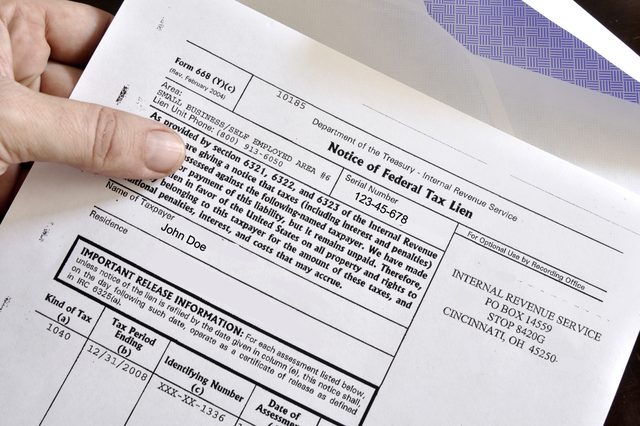
Letter 3172 - Notice of Federal Tax Lien Filing and Your Rights to a Hearing under IRC 6320

This letter is to notify you the IRS filed a notice of tax lien for the unpaid taxes. If you do not agree you can request appeals consideration within 30 days from the date of the letter. The letter and publications explain how to request a hearing from Appeals. You need to file a Form 12153, Request for A Collection Due Process Hearing and send it to the address shown on your lien notice within 30 days from the date of the letter in order to appeal the action with the Office of Appeals.

Notices

CP 90 - Final Notice of Intent to Levy

CP 90 notifies you of your unpaid taxes and that the IRS intends to levy to collect the amount owed. This notice and referenced publications explain how to request an appeal if you do not agree. You need to file a Form 12153, Request for A Collection Due Process Hearing and send it to the address shown on your levy notice within 30 days from the date of the letter in order to appeal the action with the Office of Appeals.

CP 92 - Notice of Levy upon Your State Tax Refund

CP 92 notifies you that the IRS levied your state tax refund to pay your unpaid federal taxes. This notice and referenced publications explain how to request an appeal if you do not agree. You need to file a Form 12153, Request for A Collection Due Process Hearing and send it to the address shown on your levy notice within 30 days from the date of the letter in order to appeal the action with the Office of Appeals.

CP 242 - Notice of Levy upon Your State Tax Refund

CP 242 notifies you that the IRS levied your state tax refund to pay your unpaid federal tax. This notice and referenced publications explain how to request an appeal if you do not agree. You need to file a Form 12153, Request for A Collection Due Process Hearing and send it to the address shown on your levy notice within 30 days from the date of the letter in order to appeal the action with the Office of Appeals.

CP 523 - IMF Installment Agreement Default Notice

CP 523 notifies you that the IRS intends to terminate your installment agreement in 30 days. You have the right to request an appeal if you do not agree by following the instructions in the notice.

CP 2000

You receive this letter when the IRS receives income, deduction or credit information that does not match your return. You are provided a computation of the proposed adjustments to your tax return based upon this information. If you agree, you sign and return the agreement forms. If you do not agree, you can submit a request for appeal/protest to the office/individual that sent you the letter. The letter explains how to file a protest. You need to file your protest within 30 days from the date of this letter in order to appeal the proposed adjustments with the Office of Appeals.

If you are serious about resolving your tax problem and getting tax relief, then do not compromise on your representation. Call Mike Habib, EA today at 1-877-78-TAXES or online at http://www.myirstaxrelief.com

June 12, 2009

Cell phone taxability?

Make any personal calls on that company cell phone? That's a "fringe benefit" of your job, according to a 20-year-old law, and the IRS is looking to collect.

The Wall Street Journal reports that the IRS wants to step up enforcement of the 1989 law, which holds that employees who make personal calls on a company cell phone are getting a "fringe benefit" from their employers--a benefit that should count as taxable income.

The law has been "long ignored" by employees and employers alike, according to the Journal, namely because most companies don't have the time or the inclination to tabulate exactly how many minutes you're on the phone with clients versus how often you're gabbing with friends and family.

But now, the IRS is floating a couple of proposals to make compliance easier--for employers, anyway. One would be to simply treat 25 percent of your company cell phone bill as a "fringe"--and therefore taxable--benefit, the Journal reports. Or, an employer could use "statistical sampling" to guesstimate how many of your cell minutes are work-related and which aren't.

OK, but what if you swear on a stack of bibles that you rarely, if ever, use your company phone for personal calls? That's fine, the IRS says--but you'll have to produce separate work and personal cell phone bills to prove it.

Think it's a crazy idea? Apparently the IRS is thinking it over and will make a decision by September, the Journal reports.

Meanwhile, guess who's on your side against the IRS? The big cell phone carriers, who (according to the WSJ story) are worried that companies will drop employee cell phone contracts if the IRS goes ahead with its proposal. (Instead, employers might simply reimburse you for business calls made on your personal phone.)

So, quick show of hands: How many of you have a company-issued cell phone, and if so, do you use it for personal calls? And should personal calls count as a "fringe," taxable benefit? Or should the IRS allow for (at the very least) "minimal personal use" of company phones, especially given that bosses often expect cell-toting employees to be in contact at all times?

For tax relief services, please contact Mike Habib by clicking HERE.

March 2, 2009

Tax changes you should be aware of

How individuals are affected by tax changes in the American Recovery and Reinvestment Act of 2009

Mike Habib, EA Tax Relief & Tax Problem Resolution

The American Recovery and Reinvestment Act of 2009 (commonly referred to as the Recovery Act), which was signed into law on Feb. 17, 2009, makes a number of beneficial tax changes for individuals. However, most of them are temporary in nature, that is, unless extended by future legislation, they apply for 2009 only or in some cases for 2009 and 2010. Here's a review of the more widely applicable provisions that could have an impact on you and your family.

New Making Work Pay Credit. Individuals who work generally get a credit of up to $400 ($800 for joint filers). The credit is refundable, meaning you get it even if you owe no income tax. This change applies for 2009 and 2010. The credit is the lesser of 6.2% of your earned income or $400 ($800 on a joint return). The credit is phased out for joint filers with modified adjusted gross income between $150,000 and $190,000 and other taxpayers with modified AGI between $75,000 and $95,000.

You won't be getting a separate check from the IRS, as you did with last year's Stimulus payment. Rather, your employer will automatically adjust your withholding so that you will get a little more money in each paycheck. If you have multiple jobs, you may have to adjust your withholding so that too much is not taken out. If you are self-employed, you can effectively receive the credit in advance by reducing your estimated tax payments.

One-time $250 payment or credit for others. The Recovery Act provides a one-time payment of $250 in 2009 to retirees, disabled individuals and SSI recipients receiving benefits from the Social Security Administration, Railroad Retirement beneficiaries, and disabled veterans receiving benefits from the U.S. Department of Veterans Affairs. It also provides a one-time refundable tax credit of $250 in 2009 to certain government retirees who are not eligible for Social Security benefits. The Making Work Payment credit is reduced by any $250 payment or credit received.

New sales tax deduction for vehicle purchases. For 2009, there is a new deduction for state and local sales and excise taxes paid on the purchase of new cars, light trucks, motor homes and motorcycles after Feb. 16, 2009 and before Jan. 1, 2010. The deduction generally is available regardless of whether you itemize deductions on Schedule A or claim the standard deduction.

The deduction is limited to the tax on up to $49,500 of the purchase price of an eligible motor vehicle. The deduction is phased out for joint filers with modified adjusted gross income between $250,000 and $260,000 and other taxpayers with modified AGI between $125,000 and $135,000.

If you itemize and choose the option to deduct state sales taxes in lieu of state income taxes, you don't get the new deduction. This prevents you from getting a double deduction for the sales taxes on the vehicle but it also involves some tricky planning considerations because different rules apply to the optional deduction and the new deduction. For example, the new deduction but not the optional deduction is allowed against the alternative minimum tax. Additionally, the optional deduction is subject to a limitation that caps the deduction for sales tax on a motor vehicle to the general sales tax rate.

Improved first-time homebuyer credit. Last year's Housing Act included a refundable tax credit for first-time homebuyers equal to the lesser of 10% of the purchase price or $7,500 for qualifying purchases after Apr. 1, 2008 and before July 1, 2009. The credit is essentially an interest-free loan because it has to be paid back to the government over 15 years.

The Recovery Act has improved the credit for 2009 purchases by (1) eliminating the requirement to pay it back (subject to exceptions), (2) increasing the maximum credit to $8,000, and (3) making it available for purchases through November 2009.

You can treat a 2009 purchase as having been made on Dec. 31, 2008 and thus get an immediate refund when you file your 2008 taxes by the Apr. 15, 2009 filing deadline. Even if you have already filed your 2008 taxes, you can file an amended 2008 return to get the credit for a 2009 purchase.

You are considered a first-time homebuyer if you or (or your spouse, if married) had no present ownership interest in a principal residence in the U.S. during the 3-year period before the purchase of the home to which the credit applies.

The first time homebuyer credit, whether claimed in 2008 or 2009, phases out for individual taxpayers with modified adjusted gross income between $75,000 and $95,000 ($150,000-$170,000 for joint filers).

AMT relief. In general terms, to find out if you owe alternative minimum tax (AMT), you start with regular taxable income, modify it with various adjustments and preferences (such as addbacks for property and income tax deductions and dependency exemptions), and then subtract an exemption amount (which phases out at higher levels of income). The result is multiplied by an AMT tax rate of 26% or 28% to arrive at the tentative minimum tax. You pay the AMT only if the tentative minimum tax exceeds your regular tax bill. Although it was originally enacted to make sure that wealthy individuals did not escape paying taxes, the AMT has wound up ensnaring many middle-income taxpayers. Exemption amounts were scheduled to drop and fewer tax credits were to be available to offset AMT for 2009. The Recovery Act provides AMT relief for 2009 by (1) increasing the exemption amounts above last year's levels and (2) allowing nonrefundable credits to offset AMT as well as regular tax.

College tax breaks. The Recovery Act expands tax breaks for individuals seeking a college education. For 2009 and 2010, it gives taxpayers a new "American Opportunity" tax credit of up to $2,500 of the cost of tuition and related expenses paid during the tax year. You receive a tax credit based on 100% of the first $2,000 of tuition and related expenses (including books) paid during the tax year and 25% of the next $2,000 of tuition and related expenses paid during the tax year. The credit is available for the first four years of post-secondary education in a degree or certificate program. Forty percent of the credit is refundable. The credit is phased out for taxpayers with modified AGI between $80,000 and $90,000 ($160,000 and $180,000 for joint filers).

Section 529 Education Plans are tax-advantaged savings plans that can be used to pay qualified education expenses, including: tuition, room & board, mandatory fees and books. Under the Recovery Act, for 2009 and 2010, qualified education expenses under these plans include computer technology and equipment, as well as Internet access and related services.

Tax break for the unemployed. Unemployment compensation benefits ordinarily are fully taxable. However, under the Recovery Act, an individual does not have to pay tax on up to $2,400 in unemployment benefits received in 2009.

Limited subsidy for COBRA continuation coverage of unemployed workers. The Recovery Act provides a 65% subsidy for COBRA continuation premiums for up to 9 months for workers who have been involuntarily terminated, and for their families. This subsidy also applies to health care continuation coverage if required by states for small employers. To qualify for premium assistance, a worker must be involuntarily terminated between Sept. 1, 2008 and Dec. 31, 2009. Workers who were involuntarily terminated between Sept. 1, 2008 and Feb. 17, 2009, but failed to initially elect COBRA because it was unaffordable, must be given an additional 60 days to elect COBRA and receive the subsidy. The subsidy is not taxable when received, but higher income recipients--those with modified adjusted gross income above $125,000 ($250,000 for joint filers)--will have to pay back part or all of it at tax return time.

Refundable child credit expanded. A taxpayer receives a $1,000 tax credit for each qualifying child under the age of 17. Before the Recovery Act, this credit was refundable only to a limited extent. The Recovery Act makes the child credit refundable to a much greater extent for 2009 and 2010.

Bigger earned income tax credit (EITC). The Recovery Act makes various changes to the earned income tax credit for 2009 and 2010. These changes will result in a bigger EITC for some taxpayers. For example, in 2009, taxpayers with three or more qualifying children may claim a credit of 45% of earnings up to $12,570, resulting in a maximum credit of $5,656.50.

Increased transit and vanpool transportation fringe benefits. For months beginning on or after Mar. 1, 2009 and before Jan. 1, 2011, the Recovery Act increases the monthly exclusion for employer-provided transit and vanpool benefits from $120 to $230. This figure is adjusted for inflation each year and could go up in 2010.

Improved energy tax breaks. The Recovery Act includes a number of provisions that are designed to promote the creation and use of alternative forms of energy including these new or improved energy tax breaks for individuals:

  • The Recovery Act extends the tax credit for energy-efficient improvements to existing homes through 2010 and modifies it in various ways so that a larger credit is possible after 2008.
  • Under pre-Recovery Act law, individuals could claim a 30% tax credit for qualified solar water heating property (capped at $2,000), qualified small wind energy property (capped at $500 per kilowatt of capacity, up to $4,000), and qualified geothermal heat pumps (capped at $2,000). For tax years beginning after 2008, the Recovery Act removes these individual dollar caps. As a result, each of these types of improvements is eligible for an uncapped 30% credit.
  • The Recovery Act modifies and increases the existing new qualified plug-in electric drive vehicle credit.
  • For vehicles bought after Feb. 17, 2009 and before Jan. 1, 2012, the Recovery Act creates a new 10% nonrefundable personal credit for electric drive low-speed vehicles, motorcycles, and three-wheeled vehicles.
  • For property placed in service after Feb. 17, 2009 and before Jan. 1, 2012, the Recovery Act creates a new 10% credit, up to $4,000, for the cost of converting any motor vehicle into a qualified plug-in electric drive motor vehicle.

Get tax relief and resolve your tax matters by contacting the tax firm of Mike Habib, EA at 1-877-78-TAXES or online at myirstaxrelief.com

February 28, 2009

Form 5405 First-Time Homebuyer Credit

Newly revised 2008 Form 5405, First-Time Homebuyer Credit, reflects Recovery Act IR 2009-14 Mike Habib, EA Tax Relief & Tax Problem Resolution In a news release issued on Feb. 25, 2009, IRS has announced that it has posted a revised version of the 2008 Form 5405, First-Time Homebuyer Credit, to reflect recent improvements to the credit made the American Recovery and Reinvestment Act of 2009 (Recovery Act, P.L. 111-5). Pre-Recovery Act credit. Under pre-Recovery Act law, for qualifying purchases of principal residences in the U.S. after Apr. 8, 2008 and before July 1, 2009, eligible first-time homebuyers may claim a refundable tax credit equal to the lesser of 10% of the purchase price of a principal residence or $7,500 ($3,750 for married individuals filing separately). A taxpayer is considered a first-time homebuyer if he (or spouse, if married) had no present ownership interest in a principal residence in the U.S. during the 3-year period before the purchase of the home to which the credit applies. Eligible first-time homebuyers who purchase a principal residence after Dec. 31, 2008, and before July 1, 2009, may elect to treat the purchase as made on Dec. 31, 2008. For eligible purchases in 2009, a taxpayer may elect to claim the credit for 2008 or 2009 by attaching Form 5405 to the taxpayer's original or amended 2008 tax return or 2009 tax return. The first-time homebuyer credit phases out for individual taxpayers with modified AGI between $75,000 and $95,000 ($150,000-$170,000 for joint filers) for the year of purchase. The credit for new homebuyers is recaptured ratably over fifteen years, with no interest charge, beginning with the second tax year after the tax year in which the home is purchased. For each tax year of the 15-year recapture period, the credit is recaptured as an additional income tax amount equal to 6⅔% of the amount of the credit. This repayment obligation may be accelerated or forgiven under certain exceptions.

Observation: In other words, the credit for new homebuyers is the equivalent of a long-term interest-free loan from the government.

Recovery Act enhancements to the credit. For residences purchased after 2008, Sec. 1006 of the Recovery Act:
  • increases the maximum homebuyer credit to $8,000. (Code Sec. 36(b))
  • extends the credit so that it applies to purchases before Dec. 1, 2009. (Code Sec. 36(h))
  • correspondingly, for purposes of the election to treat the purchase of a principal residence as having been made on Dec. 31, 2008, extends the last date of purchase has until Nov. 30, 2009. (Code Sec. 36(g))
  • generally waives the recapture of the credit for qualifying home purchases after Dec. 31, 2008. However, if the taxpayer disposes of the home or the home otherwise ceases to be the principal residence of the taxpayer within 36 months from the date of purchase, the pre-Recovery Act rules for recapture of the credit apply. (Code Sec. 36(f)(4)(D))

Observation: Committee reports indicate that this waiver of the recapture applies without regard to whether the taxpayer elects to treat the purchase in 2009 as occurring on Dec. 31, 2008, which is allowed by Code Sec. 36(g).

Form 5405. Form 5405 is fairly straightforward. Part I A calls for the address of the home qualifying for the credit while Part I B asks for the date it was acquired. A box must be checked on Part I C if the taxpayer is choosing to claim the credit for a home bought in 2009.

Observation: Specifically, Part I C calls for the box to be checked "[i]f you are choosing to claim the credit on your 2008 return for a main home bought after December 31, 2008 and December 1, 2009." Thus, Form 5405 reflects the Recovery Act change making this option available for a main home bought Dec. 31, 2008 and before Dec. 1, 2009.

Observation: The election effectively allows eligible first-time homebuyers who make a timely purchase in 2009 to claim the credit on their 2008 returns rather than on their 2009 returns. Thus, in some cases, an individual or couple may be able to get a refund of the credit shortly after the purchase closes and use the refund to pay off a short-term bridge loan that was obtained to help with closing costs.

Observation: A taxpayer whose 2009 qualifying home purchase will be completed after the Apr. 15, 2009 due date for filing the 2008 return should considering getting an automatic six-month filing extension if he would otherwise have to pay tax by the Apr. 15 due date and he is virtually certain to complete the purchase within the extended due date. The credit will be available to offset the tax he otherwise would have had to pay by the regular due date. If the credit won't be sufficient to completely offset the tax, he will have to pay the shortfall with his extension request. This approach should not be undertaken if the home purchase could fall through.

Part II of Form 5405 has six line entries for computing the credit. The maximum credit is computed on line 1 as the smaller of $7,500 ($8,000 for a home purchased in 2009) or 10% of the purchase price of the home. Lines 2 through 5 deal with the phaseout rules. The ultimate amount of the credit is entered on line 6.

Observation: The parenthetical language containing the $8,000 figure for 2009 purchases on the revised 2008 Form 5405 thus makes it clear that a qualifying 2009 purchaser who elects to claim the credit on his 2008 return is not limited to a maximum credit of $7,500 but rather can take advantage of the increased maximum credit of $8,000.

The instructions to Form 5405 explain the rules for repaying the credit. There are separate discussions of the rules for homes purchased in 2008 and those for home purchased in 2009. The latter reflect the Recovery Act change generally waiving the recapture of the credit for qualifying home purchases after Dec. 31, 2008.

Observation: Inclusion of the relaxed recapture rules for 2009 purchases on the 2008 Form 5404 thus makes it clear that IRS agrees that a 2009 purchaser who elects to treat the purchase as occurring on Dec. 31, 2008 gets the benefit of the relaxed recapture rules.

Get tax relief and resolve your tax matters by contacting the tax firm of Mike Habib, EA at 1-877-78-TAXES or online at myirstaxrelief.com

February 28, 2009

Obama Business Tax Impact

The American Recovery and Reinvestment Act of 2009 (commonly referred to as the Recovery Act), which was signed into law on Feb. 17, 2009, makes a number of beneficial changes for business. Here's a review of the more widely applicable provisions that could have an impact on you and your enterprise.

Mike Habib, EA Tax Relief & Tax Problem Resolution

Liberal expensing limits continued for another year. The Recovery Act gave a one-year lease on life to enhanced expensing rules, which allow qualifying businesses the option to currently deduct the cost of business machinery and equipment, instead of recovering its cost via depreciation over a number of years. For tax years beginning in 2009, the maximum amount that a business may expense is $250,000, and the expensing election begins to phase out when a business buys more than $800,000 of expensing-eligible assets. These dollar limits are the same as those that were in effect for 2008. Had the Recovery Act not been passed and signed into law, the dollar limits would have dropped this year to $133,000 and $530,000 respectively.

Bonus first year depreciation extended for another year, too. Bonus depreciation was supposed to go off the books for most assets placed in service after 2008. Fortunately, the Recovery Act extends for another year the ability for businesses to take an extra "bonus" depreciation deduction for the first year new assets are placed in service. The bonus first-year depreciation deduction generally equals 50% of the cost of qualified property (most types of tangible property other than buildings and their structural components, improvements to certain types of leased property, and most software) acquired and placed in service during 2009. Certain types of property with a long life, and certain types of aircraft, may be placed in service before Jan. 1, 2011, and still qualify for the 50% bonus first year depreciation allowance. Also, note that the otherwise allowable first-year depreciation deduction for business autos first placed in service in 2009 is hiked by $8,000 thanks to the Recovery Act.

Extended election to speed up recognition of accumulated AMT and R&D credits instead of claiming bonus depreciation. Many corporations are struggling and can't make good use of the bonus depreciation break. A law enacted last year gave such corporations an alternative tax break. For tax years ending after Mar. 31, 2008, corporations otherwise eligible for bonus depreciation for qualifying assets placed in service in 2008 (or 2009 for certain longer lived assets) could instead elect to accelerate recognition of part of their accumulated pre-2006 research tax credits or certain alternative minimum tax credits. The Recovery Act extends this election so that it is available for property placed in service in 2009 (or 2010 for certain longer lived assets). Please note that this alternative choice is highly specialized and requires a detailed analysis of a corporation's tax situation.

Deferred tax on debt forgiveness income when debt is repurchased. A business generally will wind up with debt discharge income if it repurchases its debt for less than the outstanding amount of the debt. For debt that's repurchased in 2009 or 2010, the Recovery Act permits the tax that's owed on such debt discharge income to be paid over five years, beginning with 2014.

Small businesses may elect longer NOL carryback period. In general, net operating losses (NOLs) may be carried back two years and forward 20 years (different rules apply for certain specialized types of losses). For NOLs arising in a tax year beginning or ending in 2008, the Recovery Act permits small businesses to elect to increase the NOL carryback period from two years to three, four, or five years. A small business for this purpose is a trade or business (including one conducted in or through a corporation, partnership, or sole proprietorship) whose average annual gross receipts are $15 million or less for the three-tax-year period (or shorter period of existence) ending with the tax year before the year in which the loss arose. The longer NOL carryback period gives small businesses that experienced losses the ability to get refunds of income taxes paid in earlier years. The refunds can be used to fund capital investment or other expenses.

S corporation built-in gain holding period shortened temporarily. An S corporation generally is not subject to tax; instead, it passes through its income or loss items to its shareholders, who pay tax on their pro-rata shares of the S corporation's income. However, if a business that was formed as a C corporation elects to become an S corporation, the S corporation is taxed at the highest corporate rate (currently 35%) on all gains that were "built-in" at the time of the election if the gains are recognized during a special holding period. This holding period is the first ten S corporation years. (Similar rules apply if an S corporation receives property from a C corporation in certain nontaxable transfers.) Thanks to the Recovery Act, for tax years beginning in 2009 and 2010, the special holding period is shortened to seven years.

Bigger exclusion for sale of qualified small business stock. Before the Recovery Act, individuals could exclude 50% of their gain on the sale of qualified small business stock (QSBS) held for at least five years (60% for certain empowerment zone businesses). To qualify, a QSBS must meet a number of conditions (e.g., its gross assets can't exceed $50 million and it must meet active business requirements). Under the Recovery Act, the percentage exclusion for QSBS sold by an individual increases to 75% for stock acquired after Feb. 17, 2009 and before Jan. 1, 2011.

Reduced estimated taxes in 2009 for individuals with small businesses. To the extent that tax isn't collected through withholding, taxpayers generally must make quarterly estimated payments of the "required annual payment." The required annual payment is the lesser of: (1) 90% of the tax shown on the return or (2) 100% of the tax shown on the preceding year's return (110% if adjusted gross income (AGI) for the preceding year exceeded $150,000). The Recovery Act provides that for a tax year beginning in 2009, the required annual payment for individuals with small businesses is the lesser of (1) 90% of the tax shown on the return for the tax year, or (2) 90% of the tax shown for the preceding tax year. An individual qualifies for this relaxed estimated tax payment rule only if: AGI on preceding year's return is less than $500,000 ($250,000 if married filing separately); and at least 50% of the gross income shown on the previous year's return was from a small trade or business (one that employed no more than 500 people, on average, during the calendar year ending in or with the preceding tax year).

More workers eligible for work opportunity tax credit (WOTC). Employers that hire workers from one or more targeted groups (e.g., long term family assistance recipients) can claim a tax credit that varies with the type of person hired. For individuals beginning work for the employer after Dec. 31, 2008, the Recovery Act creates a new targeted group for the WOTC, consisting of unemployed veterans and disconnected youth who begin work for the employer in 2009 or 2010.

Get tax relief, IRS Tax Help and resolve your tax matters by contacting the tax firm of Mike Habib, EA at 1-877-78-TAXES or online at myirstaxrelief.com