Recently in Unfiled Tax Returns Category

November 27, 2012

Unfiled Tax Returns - Get It Done

Unfiled Tax Returns - Get It Done

Did you know that every year many people and businesses face the gavel just because they haven't filed their taxes? Though you may plead not guilty, the IRS doesn't think so. In its eyes every person who hasn't filed their taxes is an offender even though the perspective is different from the person's view. It isn't uncommon that every year people and businesses fail to file their tax returns. Sometimes it's due to ignorance, sometimes not enough information, sometimes to escape it. It doesn't matter what the situation is, people and businesses are being heavily penalized just because of their unfiled tax returns.

Continue reading "Unfiled Tax Returns - Get It Done " »

September 2, 2011

IRS Provides Tax Relief to Victims of Hurricane Irene

Updated 9/02/11 to reflect expanded federally declared disaster area.

The Internal Revenue Service is providing tax relief to individual and business taxpayers impacted by Hurricane Irene.

The IRS announced today that certain taxpayers in North Carolina, New Jersey, New York, Vermont and Puerto Rico will receive tax relief, and other locations are expected to be added in coming days following additional damage assessments by the Federal Emergency Management Agency (FEMA).

The tax relief postpones certain tax filing and payment deadlines to Oct. 31, 2011. It includes corporations and businesses that previously obtained an extension until Sept. 15, 2011, to file their 2010 returns and individuals and businesses that received a similar extension until Oct. 17. It also includes the estimated tax payment for the third quarter of 2011, which would normally be due Sept. 15.

Continue reading "IRS Provides Tax Relief to Victims of Hurricane Irene" »

August 17, 2011

Tax Relief for Victims of Storms and Floods in Missouri and Nebraska

Tax Relief - Tax Debt Relief - IRS Tax Relief - Tax Relief and tax resolution

ST. LOUIS -- Victims of flooding beginning on June 1, 2011, in parts of Missouri may qualify for tax relief from the Internal Revenue Service.

The President has declared Andrew, Atchison, Buchanan, Holt, Lafayette and Platte counties a federal disaster area. Individuals who reside or have a business in these localities may qualify for tax relief.

As a result, the IRS has postponed until Aug. 1, 2011, certain deadlines occurring from June 1 to Aug. 1 that affect taxpayers who live or have a business in the disaster area. This includes the June 15 deadline for making estimated tax payments.

Continue reading "Tax Relief for Victims of Storms and Floods in Missouri and Nebraska" »

March 20, 2011

Back taxes help: tax levy relief for IRS tax problems

Do you owe unpaid back taxes? There are tax relief solutions to your IRS tax problems.

The IRS could file a federal tax lien to protect the US government from the back taxes owed by the taxpayer. Although the federal IRS tax lien attaches to all the taxpayer's property, some property is exempt from the IRS levy. The following items could be exempt from levy to some extent:

(1) wearing apparel and school books,
(2) fuel, provisions, furniture, and personal effects: up to $8,250 for 2010 ($8,370 for 2011),
(3) unemployment benefits,
(4) books and tools of a trade, business, or profession: up to $4,120 for 2010 ($4,180 for 2011),
(5) undelivered mail,
(6) certain annuity and pension payments,
(7) workers' compensation,
(8) judgments for support of minor children,
(9) certain AFDC, social security, state and local welfare payments and Job Training Partnership Act payments,
(10) certain amounts of wages, salary, and other income, and
(11) certain service-connected disability payments ( Code Sec. 6334(a)).

If you owe back taxes, you should note that certain specified payments are not exempt from levy, wage garnishment and bank levy, if the Secretary of the Treasury approves the levy. Among the items so covered are certain wage replacement payments as specified at Code Sec. 6334(f).

If you're seeking back taxes help, the IRS may not seize any real property used as a residence by the taxpayer or any real property of the taxpayer (other than rental property) that is used as a residence by another person in order to satisfy a liability of $5,000 or less (including tax, penalties and interest). In the case of the taxpayer's principal residence, the IRS may not seize the residence without written approval of a federal district court judge or magistrate ( Code Sec. 6334(a)(13) and (e)). Unless the collection of the back tax is in jeopardy, tangible personal property or real property (other than rented real property) used in the taxpayer's trade or business may not be seized without written approval of an IRS district or assistant director. Such approval may not be given unless it is determined that the taxpayer's other assets subject to IRS collection are not sufficient to pay the amount due and the expenses of the proceedings. Where a levy is made on tangible personal property essential to the taxpayer's trade or business, the IRS must provide an accelerated appeals process to determine whether the property should be released from levy ( Code Sec. 6343(a)(2)).

Also, if you owe back taxes, tax levies are prohibited if the estimated expenses of the levy and sale exceed the fair market value of the property ( Code Sec. 6331(f)). Also, unless the collection of the back tax is in jeopardy, a levy cannot be made on any day on which the taxpayer is required to respond to an IRS summons ( Code Sec. 6331(g)). Financial institutions, such as banks and brokerage firms, are required to hold amounts levied or garnished by the IRS for 21 days after receiving notice of the levy to provide the taxpayer time to notify the IRS of any errors or possible resolve their back tax matters ( Code Sec. 6332(c)).

Keywords: back taxes, back taxes help, stop IRS tax levy, stop wage garnishment, stop bank levy, payroll tax problems, IRS tax lien release withdrawal, tax relief, tax resolution services, IRS tax problem

We provide back taxes help in all 50 states including Alabama, Alaska, Arizona, Arkansas, California, Colorado, Connecticut, Delaware, District of Columbia, Florida, Georgia, Guam, Hawaii, Idaho, Illinois, Indiana, Iowa, Kansas, Kentucky, Louisiana, Maine, Maryland, Massachusetts, Michigan, Minnesota, Mississippi, Missouri, Montana, Nebraska, Nevada, New Hampshire, New Jersey, New Mexico, New York, North Carolina, North Dakota, Ohio, Oklahoma, Oregon, Pennsylvania, Puerto Rico, Rhode Island, South Carolina, South Dakota, Tennessee, Texas, Utah, Vermont, Virginia, Washington, West Virginia, Wisconsin, Wyoming.

March 16, 2011

Tax resolution services by Mike Habib, EA 1-877-78-TAXES

You recently asked what will happen and what you should do in the event that you cannot pay your taxes on time. First and most importantly, don't let your inability to pay your tax liability in full keep you from filing your tax return properly and on time. It is also important to remember that an extension of time to file your tax return doesn't also extend the time to pay your tax bill. Get tax resolution services at 1-877-788-2937.

Even if you can't make full payment of your liabilities, timely filing your return and making the largest partial payment you can will save you substantial amounts in interest and penalties. Additionally, there are procedures for requesting payment extensions and installment payment arrangements which will keep the IRS from instituting its collection process (liens, property seizures, etc.) against you. Get tax resolution services at 1-877-788-2937.


Overview of the most common penalties.
The "failure to file" penalty accrues at the rate of 5% per month or part of a month (to a maximum of 25%, reached after five months) on the amount of tax your return should show you owe. The "failure to pay" penalty is gentler, accruing at the rate of only 0.5% per month or part of a month (to a maximum of 25% reached after fifty months) on the amount actually shown as due on the return. If both apply, the failure to file penalty drops to 4.5% per month, so the total combined penalty remains at 5%--thus, the maximum combined penalty for the first five months is 25%. Thereafter, the failure to pay penalty can continue at 0.5% per month for 45 more months, yielding an additional 22.5%. In total, these combined penalties can reach 47.5% of your unpaid liability in less than five years.

Both of these penalties are in addition to interest you will be charged for your late payment. If you also missed estimated tax payments, an additional penalty is tacked on for the period running from each payment's due date until the tax return due date, normally April 15th. This penalty is computed at 3% above the fluctuating federal short-term interest rate for the period. Get tax resolution services at 1-877-788-2937.

Borrowing money to pay taxes. Given the rate at which the above-mentioned penalties and interest accrues, it might be a good idea to borrow money to pay the taxes. In many situations, the rate of interest that you would pay to a family member, or even to a bank, is less overall than that which you would have to pay the IRS.

Loans from relatives or friends are often the simplest method to pay the bill. One advantage of such loans is that the interest rate will probably be low, but you must also consider that loans over $10,000 at below-market interest rates may trigger tax consequences. When loans from individuals are not available, a loan from a bank or other commercial source could be sought, but such loans are not likely to be made on favorable terms to a hard-pressed taxpayer. Moreover, interest on a loan to pay taxes is nondeductible personal interest. In contrast, if you can take out a home equity loan and use the proceeds to pay off your tax debts, you will probably be paying at a lower rate than with other types of loans, and the interest payments will be deductible even if the loan proceeds aren't used in connection with the house. Get tax resolution services at 1-877-788-2937.

Credit cards. It is relatively quick and easy to use credit cards to pay the income tax bill, whether you file your income tax return by mailing a paper copy or by computer. In addition, three companies (Official Payments Corporation at 888-872-9829, Link2Gov Corporation at 888-729-1040, and RBS WorldPay, Inc. at 888-972-9829) are authorized service providers for purposes of accepting credit card charges from both electronic and paper filers. However, credit card loans are likely to be at relatively high interest rates and the interest is not deductible. Moreover, the service providers typically charge an additional fee based on the amount you are paying.

Installment agreement request. If you cannot or prefer not to take out a loan, you might be able to defer your tax payments by requesting that the IRS enter into an installment payment agreement with you. This request is made on Form 9465 or by applying for a payment agreement online. There are various options for making your monthly installment agreement payments, including the direct debit and payroll deduction methods, both of which are made automatically and thus reduce the risk of default. Get tax resolution services at 1-877-788-2937.

If you file and request a payment agreement online, there are three available payment options: (1) payment in full within 10 days (which saves on interest and penalties); (2) short-term extension of up to 120 days (for which no fee is charged, but additional penalties and interest accrue); or (3) monthly payment plan (which carries an additional user fee, and interest and penalties continue to accrue on the unpaid balance).
You can also request an installment agreement on Form 9465, which can be filed along with either an e-filed or paper return. Form 9465 requires less information than the hardship extension application (described below). If the liability is under $25,000, you will not be required to submit financial statements. Even if your request to pay in installments is granted, you will be charged interest on any tax not paid by its due date. However, the late payment penalty will be half the usual rate (0.25% instead of 0.5%) if you file your return by the due date (including extensions).

The IRS charges a fee for installment agreements, which will be deducted from your first payment after your request is approved. The fee for entering into an installment agreement is regularly $105, but it is reduced to $52 when the taxpayer pays by way of a direct debit from the taxpayer's bank account. Notwithstanding the method of payment, the fee is $43 if the taxpayer is a low-income taxpayer--i.e., an individual who falls at or below 250% of the dollar criteria established by the poverty guidelines updated annually in the Federal Register by the U.S. Department of Health and Human Services. There is a $45 fee to restructure or reinstate an established installment agreement that applies regardless of income levels or method of payment.

Note that an installment agreement request can be made after the expiration of a hardship extension period (described below). Additionally, the IRS has the authority to enter into an installment agreement calling for less than full payment of the tax liability over the term of the agreement. It may do so if it determines such an agreement will facilitate partial collection of the liability.

The installment agreement may terminate, and all your taxes become due immediately, under certain circumstances (for example, if you stop making payments).

The IRS is required to enter into an installment agreement at your request (a "guaranteed installment agreement") if the following apply:
• the tax liability is $10,000 or less (not counting interest and penalties);
• within the prior 5 years you have not (i) failed to file returns or pay taxes, or (ii) entered into a previous installment agreement;
• the IRS determines the tax liability cannot be paid in full;
• the installment agreement provides for full payment within 3 years; and
• you agree to comply with the tax laws during the agreement period.
As a matter of policy, the IRS often grants guaranteed installment agreements even if taxpayers are able to fully pay their accounts.

Undue hardship extensions. You may also qualify for an extension of time to pay if you can show that payment would cause "undue hardship." Form 1127 is used to apply for an undue hardship extension, and you must attach a statement of assets and liabilities as well as an itemized list of receipts and disbursements for the 3 months preceding the tax due date. Get tax resolution services at 1-877-788-2937.

If you qualify for an undue hardship extension, you will be given an extra six months to pay the tax shown as due on your tax return. You will avoid the failure to pay penalty, but you will still be charged interest. If the IRS determines a "deficiency," i.e., that you owe taxes in excess of the amount shown on your return, the undue hardship extension can be as long as 18 months and, in exceptional cases, another 12 months can be tacked on. However, no extension will be granted if the deficiency was the result of negligence, intentional disregard of the tax rules, or fraud.

To establish undue hardship, it is not enough to show that it would just be inconvenient to pay your tax when due. For example, if you would have to sell property at a "sacrifice" price, you may qualify for an undue hardship extension. However, if a market exists, having to sell property at the current market price is not viewed as resulting in an undue hardship.

To qualify for an extension, you would have to: (i) show that you do not have enough cash and assets convertible into cash in excess of current working capital to meet your tax obligations; (ii) show you cannot borrow the amount needed except on terms that would inflict serious loss and hardship; and (iii) provide security for the tax debt. The determination of the kind of security--such as a bond, filing a notice of lien, mortgage, pledge, deed of trust, personal surety, or other form of security--will depend on the particular circumstances involved. However, no collateral is required if you have no assets.

Offer-in-compromise. Another potential way to deal with unpaid taxes is by using an offer in compromise, which is a technique that may allow you to settle your tax debt for a fraction of its face value. This option is available only if you have already filed your return but are unable to pay your taxes--in other words, it can't be requested prospectively. Get tax resolution services at 1-877-788-2937.

Like any creditor, the IRS prefers a partial payment to no payment at all. Thus, the IRS might be willing to settle your liability for less than the full amount if: (a) you aren't able to pay the full amount, (b) there is doubt as to how much the tax liability is, (c) collection of the liability would create economic hardship for you (for instance, if you are out of work due to health problems, or if sale of your assets to pay the tax would leave you without enough money to meet basic living expenses), or (d) compelling public policy or equity considerations exist, and due to the exceptional circumstances (such as a medical condition that prevents proper management of financial affairs, or reliance on erroneous advice from the IRS), the IRS's collection of the full liability would undermine public confidence in the fair and equitable administration of tax laws. Learn more about Tax Relief Options HERE.

The process is started by actually making an offer-in-compromise. If the offer is based on any reason other than doubt as to how much the tax liability is, you must submit your financial information along with the offer. If it is grounded on doubt as to the liability, the IRS is not permitted to request a financial statement. Partial payments must be made to the IRS while a periodic payment offer is being considered. For lump-sum offers, or offers involving five or fewer installments, a 20% down payment (of the total offer amount) must be made with the application.

In order to obtain an offer-in-compromise based on any of the above-mentioned grounds except doubt as to liability, you must agree to comply with all tax law rules on filing returns and paying taxes for the longer of five years or until the offered amount is paid. If you don't comply with these rules, the compromise will terminate and the IRS can seek collection of the original liability amount.

Innocent spouse relief. If you are unable to pay liabilities that are attributable to your spouse, it might be worth exploring whether you are eligible for relief under the "innocent spouse" provisions. Under limited circumstances, a taxpayer can be relieved from liabilities shown on a joint return filed with a spouse. In general, relief is potentially available for: erroneous items attributable to the other spouse of which you had no knowledge or reason to know; the separate liabilities of a spouse to whom you are no longer married or with whom you no longer reside (including deceased spouses); and liabilities for which it would otherwise be inequitable to hold you liable. This is a very specialized type of relief that carries many procedural and substantive requirements that are beyond the scope of this letter, but it's important that you're aware of it because there are strict time restrictions associated with claiming innocent spouse relief. Get tax resolution services at 1-877-788-2937.

Avoiding more serious consequences. Many taxpayers ignore their tax liabilities when they run into financial difficulties--for example, by failing to file their tax returns. However, tax liabilities do not go away if left unaddressed, and failing to deal with the problem often exacerbates it. It is very important that you timely file a properly prepared return, even if full payment cannot be made. Include as large a partial payment as you can with the return, and start working with the IRS on one (or more) of the options discussed above as soon as possible. Otherwise, you may face escalating penalties, the risk of having liens assessed against your assets and income, or even seizure and sale of your property. In many cases, these tax nightmares can be avoided by taking advantage of the arrangements offered by the IRS. Get tax resolution services at 1-877-788-2937.

Of course, I am available to discuss all of these matters with you on a strictly confidential basis and to offer advice and assistance. Please don't hesitate to call me at 1-877-788-2937.

Keywords: tax relief services, tax resolution services, IRS audit, back taxes, tax help, IRS tax help, tax attorney, enrolled agent, tax problems, tax negotiation, tax settlements, back tax help, tax help line 877-788-2937, payroll tax problem help, A rated tax resolution company,

We offer reliable tax relief and tax resolution services in all 50 states including Alabama, Alaska, Arizona, Arkansas, California, Colorado, Connecticut, Delaware, District of Columbia, Florida, Georgia, Guam, Hawaii, Idaho, Illinois, Indiana, Iowa, Kansas, Kentucky, Louisiana, Maine, Maryland, Massachusetts, Michigan, Minnesota, Mississippi, Missouri, Montana, Nebraska, Nevada, New Hampshire, New Jersey, New Mexico, New York, North Carolina, North Dakota, Ohio, Oklahoma, Oregon, Pennsylvania, Puerto Rico, Rhode Island, South Carolina, South Dakota, Tennessee, Texas, Utah, Vermont, Virginia, Washington, West Virginia, Wisconsin, Wyoming.

February 27, 2011

Tax Relief Specialists: How to Find a Reliable Tax Professional

Tax relief experts have a job pretty similar in nature to specialists of any other field. For example, if you are traveling on the road and suddenly your car breaks down due to a mechanical fault, you cannot fix it without the service of an expert mechanic, unless you possess such proficiencies. Likewise, when your IRS taxes get out of control due to financial problems, carelessness or any other reason, you need the help of a tax relief expert to carry on with your smoother journey of life. But there are many so-called experts you need to beware of, who are there only to take your money. Let us try to expose these scammers!

The American economic system relies heavily on the taxation system and this is why the IRS handles the individuals vehemently who try to evade taxes. However, in current cloudy financial circumstances paying taxes is not an easy job. If you have become a tax defaulter, need not worry because there are several legal ways out.

If you try to solve your IRS tax problems without the technical know-how expertise, it is just like trying to fix your broken car without the help of a mechanic and you will end up nowhere. If you do not want to waste your time and money, contact a reliable tax relief expert, as soon as you realize the tax problem. Procrastination will result in nothing but penalties and higher interest and you will be paying much more than the actual back taxes owed.

Is there a worse scenario than being haunted by the hostile IRS officers and you do not have enough money to pay back the taxes? Yes, if you fall a victim to fake tax relief experts. These scammers have interest in your money not in solving your problems. At the end of the day you will pay their huge fee, the whole tax amount plus penalties and interest.

The trustworthy tax relief experts usually offer free consultation before they take up your case. In this session you should ask them as many questions as you can, to assess their capabilities. If they are paying more attention to your money rather than your tax problem, go somewhere else to seek help.

On the other hand, there are honest and helpful experts who try to be as fair as possible as they know their client is in financial problems. These experts bear all the burden of representing you before the IRS, formulating the best solution for you and in the end, get you favorable results for a reasonable fee.


February 24, 2011

BBB "A" rated tax relief company by Mike Habib, EA

Mike Habib is an IRS licensed Enrolled Agent who focuses his tax practice on helping his clients resolve their tax controversy matters. His tax relief firm is rated "A" by the better business bureau, which is quite rare for this industry as many are rated "F" or already ceased business operations like American Tax Relief and Nationwide Tax Relief and possibly many more to come.

Do you have IRS tax problems?

Don't procrastinate anymore; call Mike Habib at 1-877-788-2937 for a free analysis of your tax situation. There are solutions to your tax problems.

Tax relief services provided are:

 Stopping wage garnishments and tax levies,
 Stopping and releasing bank levies,
 IRS tax audit representation
 Filing delinquent and past due tax returns,
 Resolving back tax debts,
 Negotiated settlement agreements,
 Installment agreements you can afford,
 Offer in compromise settlements,
 Sales tax audit representation and sales tax debt settlements,
 941 payroll tax resolution,
 Penalty abatement services,
 IRS Revenue Officer matters

Don't let the IRS ruin your life! Hire the reliable tax firm of Mike Habib; he has earned an "A" rating from the better business bureau.

Don't fall for scams.

Get a confidential consultation today by calling 1-877-788-2937.

Keywords: A rated BBB tax relief company, reliable tax relief company, tax resolution company that is reliable and A rated by the better business bureau, tax resolution service BBB rating

February 24, 2011

IRS tax lien: tax help for back tax problems

IRS Announces New Effort to Help Struggling Taxpayers Get a Fresh Start; Major Changes Made to IRS Tax Lien Process

IR-2011-20

IRS WASHINGTON -- In its latest effort to help struggling taxpayers, the Internal Revenue Service today announced a series of new steps to help people get a fresh start with their tax liabilities.

The goal is to help individuals and small businesses meet their tax obligations, without adding unnecessary burden to taxpayers. Specifically, the IRS is announcing new policies and programs to help taxpayers pay back taxes and avoid tax liens.

"We are making fundamental changes to our lien system and other collection tools that will help taxpayers and give them a fresh start," IRS Commissioner Doug Shulman said. "These steps are good for people facing tough times, and they reflect a responsible approach for the tax system."

Today's announcement centers on the IRS making important changes to its lien filing practices that will lessen the negative impact on taxpayers. The changes include:

• Significantly increasing the dollar threshold when liens are generally issued, resulting in fewer tax liens.
• Making it easier for taxpayers to obtain lien withdrawals after paying a tax bill.
• Withdrawing liens in most cases where a taxpayer enters into a Direct Debit Installment Agreement.
• Creating easier access to Installment Agreements for more struggling small businesses.
• Expanding a streamlined Offer in Compromise program to cover more taxpayers.
"These steps are in the best interest of both taxpayers and the tax system," Shulman said. "People will have a better chance to stay current on their taxes and keep their financial house in order. We all benefit if that happens."

This is another in a series of steps to help struggling taxpayers. In 2008, the IRS announced lien relief for people trying to refinance or sell a home. In 2009, the IRS added new flexibility for taxpayers facing payment or collection problems. And last year, the IRS held about 1,000 special open houses to help small businesses and individuals resolve tax issues with the Agency.

Today's announcement comes after a review of collection operations which Shulman launched last year, as well as input from the Internal Revenue Service Advisory Council and the National Taxpayer Advocate.

Tax Lien Thresholds
The IRS will significantly increase the dollar thresholds when liens are generally filed. The new dollar amount is in keeping with inflationary changes since the number was last revised. Currently, liens are automatically filed at certain dollar levels for people with past-due balances.

The IRS plans to review the results and impact of the lien threshold change in about a year.

A federal tax lien gives the IRS a legal claim to a taxpayer's property for the amount of an unpaid tax debt. Filing a Notice of Federal Tax Lien is necessary to establish priority rights against certain other creditors. Usually the government is not the only creditor to whom the taxpayer owes money.

A lien informs the public that the U.S. government has a claim against all property, and any rights to property, of the taxpayer. This includes property owned at the time the notice of lien is filed and any acquired thereafter. A lien can affect a taxpayer's credit rating, so it is critical to arrange the payment of taxes as quickly as possible.

"Raising the lien threshold keeps pace with inflation and makes sense for the tax system," Shulman said. "These changes mean tens of thousands of people won't be burdened by liens, and this step will take place without significantly increasing the financial risk to the government."

Tax Lien Withdrawals
The IRS will also modify procedures that will make it easier for taxpayers to obtain lien withdrawals.

Liens will now be withdrawn once full payment of taxes is made if the taxpayer requests it. The IRS has determined that this approach is in the best interest of the government.
In order to speed the withdrawal process, the IRS will also streamline its internal procedures to allow collection personnel to withdraw the liens.

Direct Debit Installment Agreements and Liens

The IRS is making other fundamental changes to liens in cases where taxpayers enter into a Direct Debit Installment Agreement (DDIA). For taxpayers with unpaid assessments of $25,000 or less, the IRS will now allow lien withdrawals under several scenarios:
• Lien withdrawals for taxpayers entering into a Direct Debit Installment Agreement.
• The IRS will withdraw a lien if a taxpayer on a regular Installment Agreement converts to a Direct Debit Installment Agreement.
• The IRS will also withdraw liens on existing Direct Debit Installment greements upon taxpayer request.

Liens will be withdrawn after a probationary period demonstrating that direct debit payments will be honored.

In addition, this lowers user fees and saves the government money from mailing monthly payment notices. Taxpayers can use the Online Payment Agreement application on IRS.gov to set-up with Direct Debit Installment Agreements.

"We are trying to minimize burden on taxpayers while collecting the proper amount of tax," Shulman said. "We believe taking away taxpayer burden makes sense when a taxpayer has taken the proactive step of entering a direct debit agreement."

Installment Agreements and Small Businesses
The IRS will also make streamlined Installment Agreements available to more small businesses. The payment program will raise the dollar limit to allow additional small businesses to participate.

Small businesses with $25,000 or less in unpaid tax can participate. Currently, only small businesses with under $10,000 in liabilities can participate. Small businesses will have 24 months to pay.

The streamlined Installment Agreements will be available for small businesses that file either as an individual or as a business. Small businesses with an unpaid assessment balance greater than $25,000 would qualify for the streamlined Installment Agreement if they pay down the balance to $25,000 or less.

Small businesses will need to enroll in a Direct Debit Installment Agreement to participate.

"Small businesses are an important part of the nation's economy, and the IRS should help them when we can," Shulman said. "By expanding payment options, we can help small businesses pay their tax bill while freeing up cash flow to keep funding their operations."

Offers in Compromise
The IRS is also expanding a new streamlined Offer in Compromise (OIC) program to cover a larger group of struggling taxpayers.

This streamlined OIC is being expanded to allow taxpayers with annual incomes up to $100,000 to participate. In addition, participants must have tax liability of less than $50,000, doubling the current limit of $25,000 or less.

OICs are subject to acceptance based on legal requirements. An offer-in-compromise is an agreement between a taxpayer and the IRS that settles the taxpayer's tax liabilities for less than the full amount owed. Generally, an offer will not be accepted if the IRS believes that the liability can be paid in full as a lump sum or through a payment agreement. The IRS looks at the taxpayer's income and assets to make a determination regarding the taxpayer's ability to pay.

Our firm specializes in tax problem resolution and could be of help. Call for a free confidential analysis of your tax situation at 1-877-788-2937.

February 21, 2011

IRS Tax Debt Relief: A Golden Opportunity to Get Rid of Your IRS Back Taxes

Good news for American taxpayers who have an outstanding IRS Tax Debt: IRS is still accepting a large number of requests for settlements of delinquent back taxes from taxpayers who are in financial distress and cannot pay their back taxes in full. However, it is a pity that even a huge number of American citizens are possibly qualified for IRS tax relief programs, yet only a small percentage has managed to settle and benefit from these programs. This article not only explores the mistakes made by the individuals who owe IRS back taxes but also explains the best line of attack to resolve your IRS problems.

Although the Internal Revenue Service is offering the taxpayers having back tax problems a solitary opportunity to say goodbye to their tax debt for good, it neither advertises nor suggests that taxpayers should make the use of their offerings. This clearly depicts that the IRS is more eager to recover its full amount instead of providing you the relief. Therefore, most of the taxpayers in financial hardship are not aware of this golden opportunity.

On the other hand, the major reason for taxpayers not being able to enjoy the tax debt settlement offer by IRS is not awareness. In fact majority of taxpayers shamble their case themselves by taking wrong steps, incorrect paperwork and various other mistakes. At the end of the day, these taxpayers have to pay much more than the actual amount owed or end up doing nothing at all.

Offer in Compromise (OIC) is obviously the best way out of IRS back taxes as you have to pay a reduced percentage of the total tax debt. In the current prevalent gloomy fiscal conditions, most of the taxpayers with unpaid back taxes and who are in financial distress and special circumstances due to different hardships, could qualify for an OIC. But as said earlier, many individuals try to negotiate with the IRS on their own and due to lack of tax knowledge and specialized skill set, their OIC request is rejected.

If you want to end your IRS back tax nightmare, you should contact a qualified and reliable tax relief expert. Mike Habib focuses his tax practice on representing his clients before all administrative levels of the IRS. Hire a reliable tax relief professional today, start a tax debt-free life tomorrow!

IRS tax debt relief offered in areas such as: Los Angeles, Whittier, Pasadena, Glendale, Burbank, Orange County, Riverside, Palm Springs, San Bernardino, Palmdale, Bakersfield, New York, New Jersey, Chicago, Houston, Phoenix, Philadelphia, San Antonio, San Diego, Dallas, San Jose, Detroit, Jacksonville, Indianapolis, San Francisco, Columbus, Austin, Memphis, Fort Worth, Baltimore, Charlotte, El Paso, Boston, Seattle, Washington DC, Milwaukee, Denver, Louisville, Jefferson, Las Vegas, Reno, Hempstead, Tucson, Nashville, Davidson, Portland, Tucson, Albuquerque, Santa Fe, Anchorage, Atlanta, Long Beach, Fresno, Sacramento, Mesa, Kansas City, Cleveland, Virginia Beach, Omaha, Miami, Oakland, Tulsa, Honolulu, Minneapolis, Pittsburgh, Colorado Springs, Arlington, Wichita, Birmingham, Montgomery, Tampa, Orlando

February 14, 2011

Tax Relief USA: IRS Tax Problems for American Citizens outside the United States

Tax relief USA is for the American citizens who are dwelling in the foreign countries. The taxation phenomenon becomes multifaceted and complex as you become taxable under the laws of two different countries. Most of the US expats do not know their rights and obligations as there is not much awareness among the commoners regarding the Tax Relief USA. This article describes the key points related to this relief program.

Let us suppose, if an American citizen is residing and working in Canada, he is obliged to pay the IRS taxes just like other citizens inside the United States. The taxpayer needs to learn the filing requirements the way they are based on American laws. However, this does not mean that he is not bound to pay the taxes under Canadian laws. Fortunately, IRS offers tax relief USA to such individuals which can lessen considerable financial burden.

So what is tax relief USA actually? Though the taxpayer must pay the taxes in both the countries but if the IRS believes that he is eligible for tax relief USA, he will either be given credit for the taxes paid in the foreign country or he will be entitled to exclude a part or the whole income earned outside the US.

There a few benefits including Canada Pension Plan, Old Age Security scheme etc. which are not taxable in the United States. Actually, this tax relief program is based on a tax treaty between the governments of the United States and Canada, which offers that such benefits would be taxed utterly on the base of current residence. In the same way, the above mentioned benefits come to be taxable if the taxpayer obtains them while residing in the USA.

Therefore, these Canadian social security benefits are preceded just like their American counterparts because of the United States tax. However, in case any of such benefits is not subject to taxation in the hands of a Canadian resident, the same benefit is not taxable in the United States.

Obviously this is not a straightforward procedure and having different taxation laws for different countries, legal tax expertise are required to understand it thoroughly. It is sensible to contact a tax relief expert to understand your rights and responsibilities.

February 7, 2011

IRS Tax Help: A Straightforward Resolution to Your IRS Problems

IRS tax problems can make your life a complete mess. Tax debt can cause never-ending strain and may also break marriages or even break families. Individuals facing IRS troubles should instantly seek tax help from a qualified tax relief professional to avoid drastic circumstances.

The IRS website is obviously the most comprehensive resource available. You can find all the tax forms, publications, instructions, frequently asked questions as well as resources for individuals, organizations, non-profits and all the other entities subject to tax under the United States laws. If you need any sort of help, documentation or information, the IRS webpage is the place to go.

Download any form from the webpage and you will immediately have the idea how exhausting it can be to fill a form without making even a minor mistake. Unfortunately, the smallest of mistakes can ruin your case and your request will be rejected no matter if you qualify for the IRS tax relief. This clearly illustrates you should seek professional help to get the best possible resolution for your tax problems.

The foremost thing you need to understand is that every individual faces a unique tax problem thus needs a unique solution and there is no one-size-fits-all formula to get rid of IRS tax issues. Furthermore, you must start taking steps to solve the problem as soon as you recognize it because delays will only infuriate the issues.

To get the best outcome, the plan is simple: identify your problem, choose an appropriate solution, complete the necessary paperwork and keep communicating with the IRS until you get all your problems solved. However, each step involved in the process, from pinpointing your issue to getting results, needs technical knowledge and specialized expertise.

IRS revenue agents and officers are pretty punitive because of the nature of their job. For many people this reason alone is enough to hire a tax relief professional instead of facing bullying demands by the IRS employees. When you hire a tax professional i.e. enrolled agent, CPA or tax attorney, you will be represented by your tax expert before the IRS. The expertise and experience of the tax resolution expert not only mean you should sit relaxed but also you can expect the best possible results.

February 1, 2011

How to stop an IRS wage garnishment

If you have received an IRS wage garnishment notice, then the IRS is going to apply a levy deduction to your hard earned paycheck, it also means that the IRS notifies your employer that you have unpaid back taxes. Your employer is then required by law to withhold and send a significant portion of each of your paychecks directly to the IRS to offset your tax debt.

Please note, that if you do not respond, the IRS will gladly continue to garnish your paycheck until your tax debt is paid in full with all the penalties and interest.

With our firm, you do not need to take on the IRS by yourself. We will work with the IRS to negotiate a full or partial levy release of your wage garnishment if you qualify for tax relief. Depending upon your own individual circumstances, we may arrange an installment agreement so you can pay the IRS a specified dollar amount every month until the unpaid taxes are paid. Once the negotiated installment agreement is in place, an offer-in-compromise may be also negotiated to settle your entire tax debt for less than you actual owe, depending on your individual financial circumstances.

Another option is to be placed in a CNC - currently not collectible status, in which you may not have to make payments to the IRS at all, again depending on your particular financial circumstances. In today's economy, most taxpayers are in a financial hardship, and now is the time to resolve your unpaid back taxes once and for all.

Please call to set up a free confidential consultation to review your options and take the stress out of dealing with your IRS wage garnishment notice.

Now is the time to act. We deal with the IRS so you don't have to.

Call Mike Habib, EA at 1-877-788-2937 to end your tax problem nightmare.

IRS wage garnishment release offered in areas such as: Los Angeles, Whittier, Pasadena, Glendale, Burbank, Orange County, Riverside, Palm Springs, San Bernardino, Palmdale, Bakersfield, New York, New Jersey, Chicago, Houston, Phoenix, Philadelphia, San Antonio, San Diego, Dallas, San Jose, Detroit, Jacksonville, Indianapolis, San Francisco, Columbus, Austin, Memphis, Fort Worth, Baltimore, Charlotte, El Paso, Boston, Seattle, Washington DC, Milwaukee, Denver, Louisville, Jefferson, Las Vegas, Reno, Hempstead, Tucson, Nashville, Davidson, Portland, Tucson, Albuquerque, Santa Fe, Anchorage, Atlanta, Long Beach, Fresno, Sacramento, Mesa, Kansas City, Cleveland, Virginia Beach, Omaha, Miami, Oakland, Tulsa, Honolulu, Minneapolis, Pittsburgh, Colorado Springs, Arlington, Wichita, Birmingham, Montgomery, Tampa, Orlando

January 21, 2011

IRS Tax Problems: We can help in solving your tax problem

Do you owe unpaid taxes to the IRS and can't pay them? We can help! One in eight Americans is facing stressful tax problems at any one point in their lives. That is considered hard, and they can't to address it on their own. Our firm understands the complexity of the unpaid tax issues and how to interact with the IRS on your behalf. Doing nothing to resolve your tax matters will not make the problem go away! If you owe back taxes, the IRS will soon be sending you a levy notice to indicate garnishment of wages, your pension check, your savings bank account, your property, and even your social security checks, yes the IRS can garnish and levy your social security check.

Now is the time to act. We deal with the IRS so you don't have to.

Call Mike Habib, EA at 1-877-788-2937 to end your tax problem nightmare.

IRS tax problem resolution offered in areas such as: Los Angeles, Whittier, Pasadena, Glendale, Burbank, Orange County, Riverside, Palm Springs, San Bernardino, Palmdale, Bakersfield, New York, New Jersey, Chicago, Houston, Phoenix, Philadelphia, San Antonio, San Diego, Dallas, San Jose, Detroit, Jacksonville, Indianapolis, San Francisco, Columbus, Austin, Memphis, Fort Worth, Baltimore, Charlotte, El Paso, Boston, Seattle, Washington DC, Milwaukee, Denver, Louisville, Jefferson, Las Vegas, Reno, Hempstead, Tucson, Nashville, Davidson, Portland, Tucson, Albuquerque, Santa Fe, Anchorage, Atlanta, Long Beach, Fresno, Sacramento, Mesa, Kansas City, Cleveland, Virginia Beach, Omaha, Miami, Oakland, Tulsa, Honolulu, Minneapolis, Pittsburgh, Colorado Springs, Arlington, Wichita, Birmingham, Montgomery, Tampa, Orlando

January 15, 2011

Tax Relief Experts: Solutions to your tax problem

IRS taxes are undoubtedly an imperative feature of the United States' economic cycle. These days only a few people pay as much attention to the taxes as required. Some people fail to formulate a proper budget and spare enough dough to pay taxes, some others make mistakes while filing returns and finally there are those who do not even bother filing a tax return. If you fall in any of these three categories, you are in danger of severe penalties by the IRS. Worried? You should. This article explains how tax relief experts can free you from this unwanted situation.

It is a fact that every taxpayer has completely different circumstances and there is no one-size-fits-all formula to solve different IRS tax problems. All you have to do is recognize your mistake, assess your financial situation, get a tax resolution plan approved by the IRS and stick to it.

However, this can be quite a challenging course and you will need the expertise of qualified tax relief experts to guide you the most optimal approach for making up for your mistake. Based on your specific situation, these experts also advise you how you can sidestep the same or other mistakes in future. Tax relief experts have three different types: tax attorneys, CPAs and enrolled agents. You can choose any of these three but enrolled agents can be a wise choice in most of the situations due to their specialization in tax system and affordable fee as compared to the others.

Fortunately, the IRS is presently offering considerable clemency and eager to negotiate and allow you to make use of their certain tax debt relief programs. If you have enough evidence that you cannot pay your taxes in full, you can get favorable concessions. Even if you are not in a position to pay your taxes entirely, you still need to convince the IRS. Once the IRS is satisfied with your story, you will be allowed to pay your tax in affordable installments or even a reduced percentage of the actual amount.

Just like you cannot cure yourself of ailments without the help of a doctor, getting the best tax relief without an expert is tough. Only your tax relief expert can get you the best solution based on your tax debt, your income and basic expenses.


November 10, 2010

Tax Help Line 1-877-78-TAXES: Stop IRS levy

Do you have tax problems? Call the reliable tax help line now at 1-877-78-TAXES [877-788-2937].

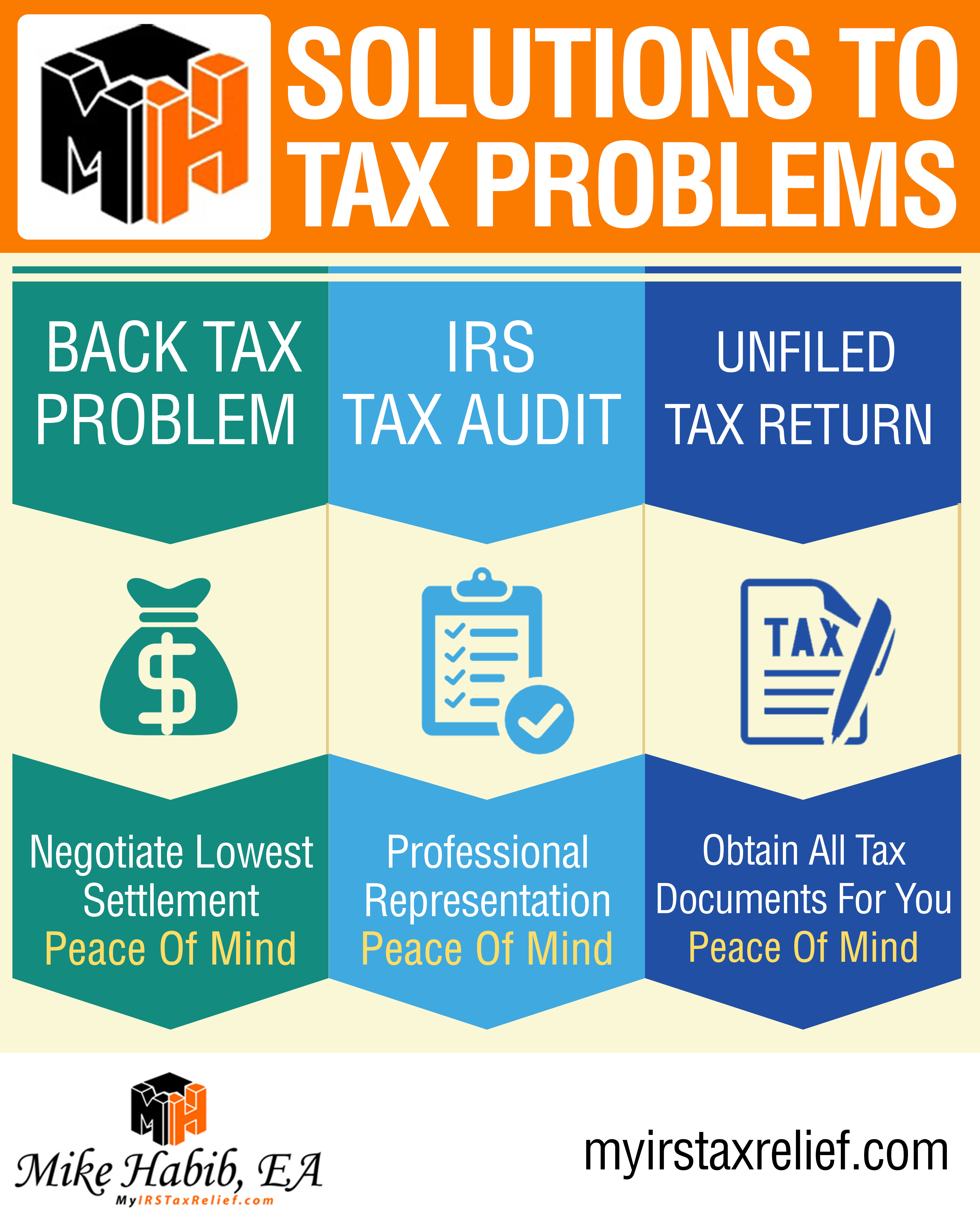
We have solutions to tax problems. If you have unfiled tax returns, call the tax help line at 877-788-2937. If you have back taxes, and cannot pay the entire amount due to financial hardships, call us and we will gladly help you. We also can represent you in case of an IRS tax audit, you will not have to face the IRS, we will represent you before all administrative levels of the IRS.

When you call our reliable tax help line, you will always speak with the principal of the firm, Mike Habib EA, so you will not speak to sales representatives like other companies do. Mike Habib will be your power of attorney and will work with you and the IRS to negotiate the lowest and best possible resolution for your tax problem.

Seeking IRS tax help? Call our tax help line at 1-877-788-2937. Taxpayers seeking back taxes help are getting tax relief through different options, negotiated installment agreement is one way to resolve your back tax problem. In this option, we negotiate the lowest payment based on your ability to pay, you will not be in a financial hardship. Other taxpayers seeking back taxes help might qualify for an offer in compromise settlement, this is usually a lump sum amount that is less than what you owe calculated based on your reasonable collection potential. Other taxpayers could get a CNC, currently non collectible, this put their account with the IRS on hold due to their negative cash flow and inability to make any payment towards their back taxes.

Whatever your tax problem is, we offer tax problem help, call for you free consultation.

Our tax helpline is 1-877-788-2937.

Our tax help line serves taxpayers in all 50 states including Alabama, Alaska, Arizona, Arkansas, California, Colorado, Connecticut, Delaware, District of Columbia, Florida, Georgia, Guam, Hawaii, Idaho, Illinois, Indiana, Iowa, Kansas, Kentucky, Louisiana, Maine, Maryland, Massachusetts, Michigan, Minnesota, Mississippi, Missouri, Montana, Nebraska, Nevada, New Hampshire, New Jersey, New Mexico, New York, North Carolina, North Dakota, Ohio, Oklahoma, Oregon, Pennsylvania, Puerto Rico, Rhode Island, South Carolina, South Dakota, Tennessee, Texas, Utah, Vermont, Virginia, Washington, West Virginia, Wisconsin, Wyoming.